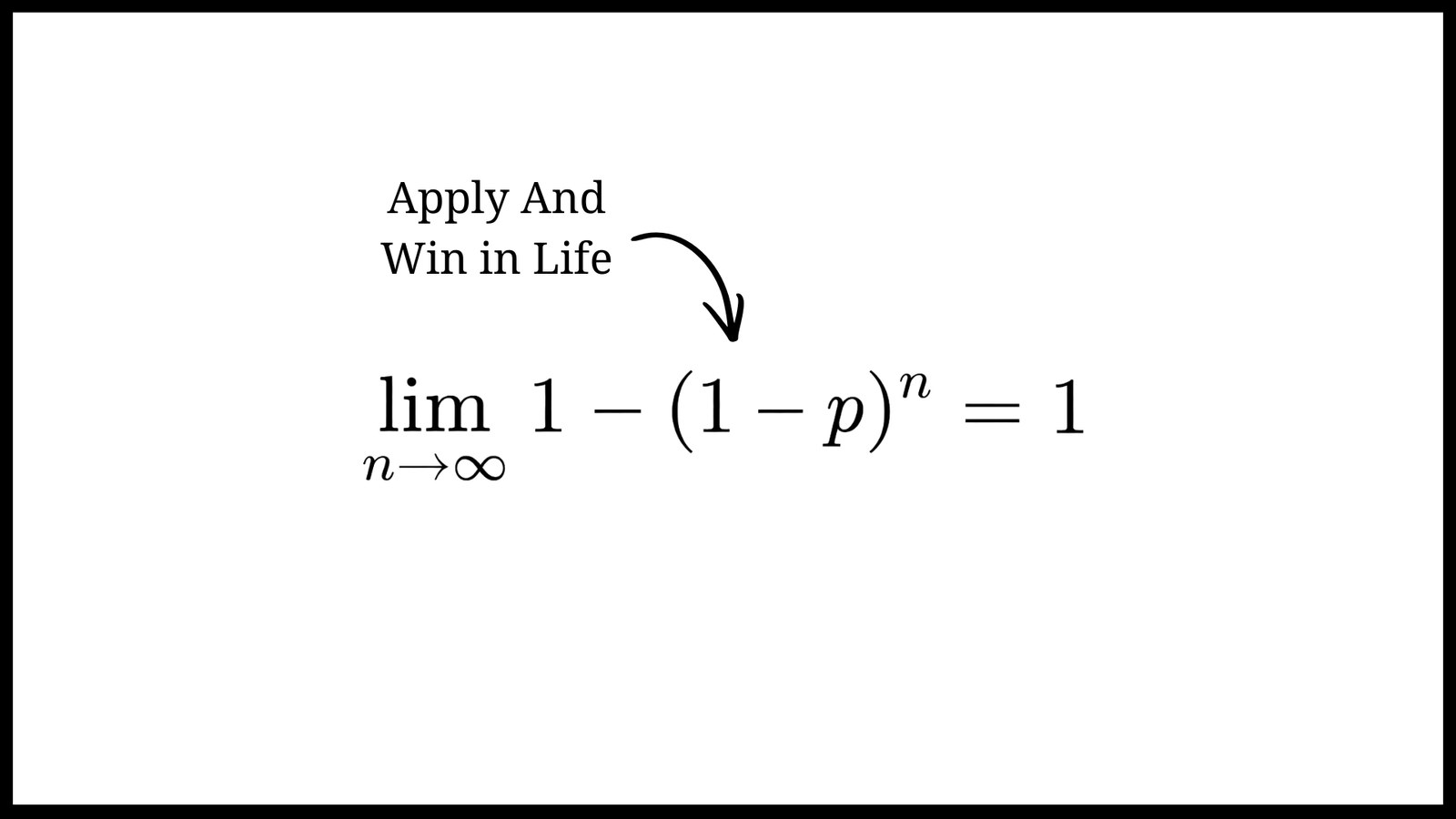
There is a very simple equation in probability theory:

It looks like textbook math.
It is actually a model of how progress works.
Let’s unpack it.
Define two variables.
p = probability of success in a single attempt
n = number of attempts
The expression –

computes the probability that you succeed at least once after n attempts.
The term ((1-p)^n) is the probability that you fail every single time.
So the equation simply says:
Probability of success = 1 − probability of failing every time.
Now look at what happens when attempts increase.
As n grows, ((1-p)^n) shrinks toward zero.
Which means:

The probability of success approaches certainty.
Not because the attempt got better.
Not because the odds changed.
Because you kept running the trial.
A Simple Example
Assume a terrible success rate.
Let p = 0.001.
That is a 0.1% chance of success per attempt.
Most people would say those odds are useless.
But run the math.
After 100 attempts
Success probability ≈ 9.5%
After 1,000 attempts
Success probability ≈ 63%
After 5,000 attempts
Success probability ≈ 99.3%
The probability of success approaches certainty.
Nothing about the attempt improved.
Only the number of attempts increased.
The Strategic Insight
Success probability has two levers.
Increase p
Increase n
Most people obsess over p.
Better plan.
More knowledge.
Perfect strategy.
But in many real systems, the dominant variable is n.
Number of experiments.
Startups work this way.
Scientific research works this way.
Venture capital works this way.
Creative work works this way.
Progress is not deterministic.
It is probabilistic search.
And probabilistic search rewards iteration velocity.
Why This Matters
Many people treat success like a single deterministic attempt.
One company.
One idea.
One shot.
That is the wrong model.
The correct model is repeated trials.
You are running a search process across a space of possibilities.
Each attempt samples the space.
The more samples you take, the higher the probability that one lands in the success region.
This is exactly how:
- evolutionary systems work
- randomized algorithms work
- scientific discovery works
Nature does not search once.
Nature searches millions of times.
The Constraint
There is one condition the equation requires.
Success must be possible.
If the probability of success is zero, infinite attempts still fail.
This is the only real strategic question:
Are you playing a game where success is possible?
If the answer is yes, the next question is simple.
How do you maximize n?
The Builder’s Strategy
Good builders optimize for iteration speed.
They design systems where attempts are:
- fast
- cheap
- reversible
- information generating
This increases the number of trials.
Which increases the probability of hitting success.
Over time the system compounds.
Approaches 1.
Persistence Is Not Philosophy
It is math.
The equation says something very precise.
If success has any non-zero probability, and you can attempt enough times, success becomes almost certain.
The real skill is not predicting the correct attempt.
The real skill is building a system where attempts never stop.
That is how probability bends in your favor.
Leave a Reply