Category: Philosophy

  • This Is the Mathematical Formula to Win Any Game

    This Is the Mathematical Formula to Win Any Game

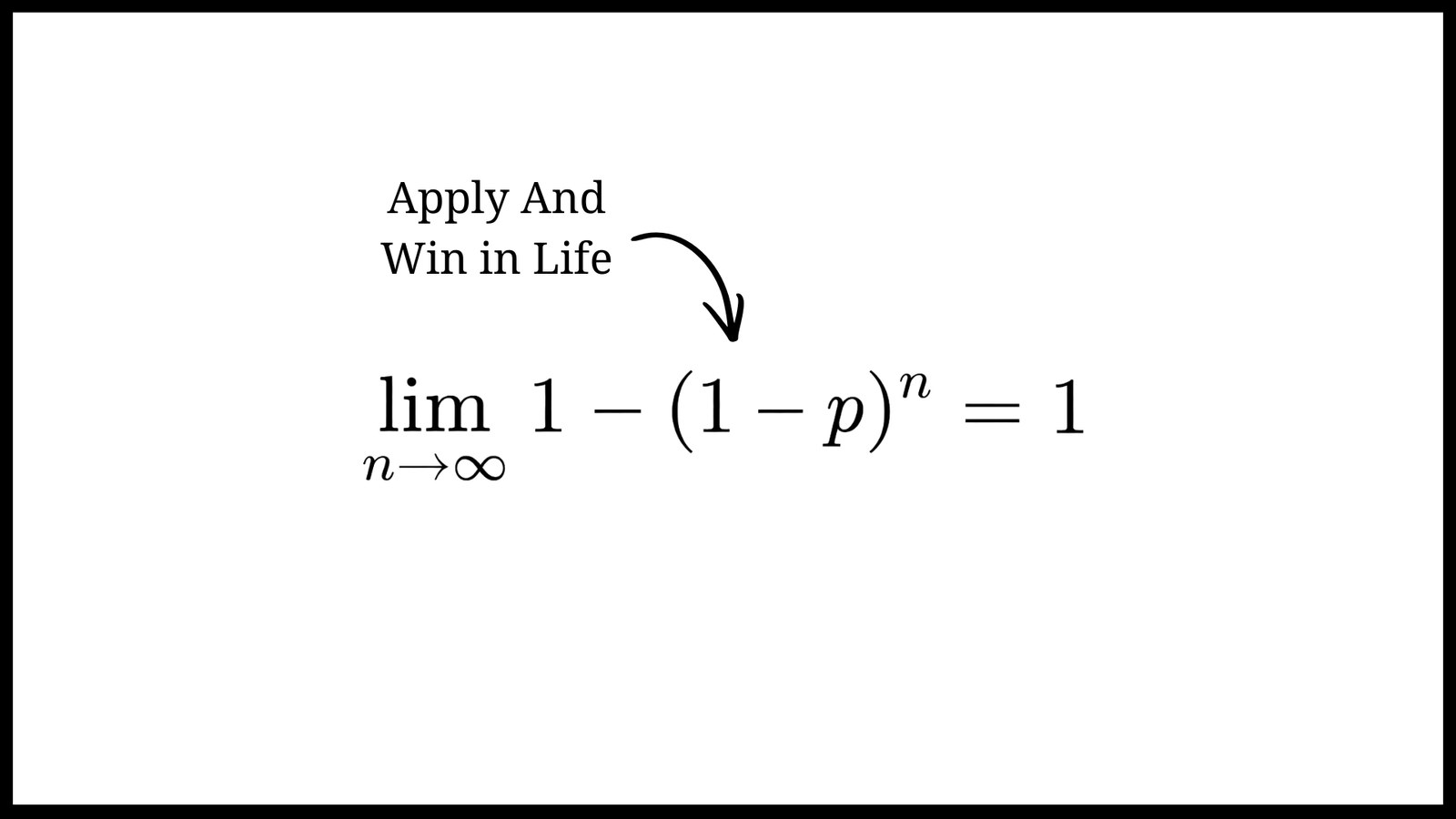
    There is a very simple equation in probability theory:

    It looks like textbook math.

    It is actually a model of how progress works.

    Let’s unpack it.

    Define two variables.

    p = probability of success in a single attempt
    n = number of attempts

    The expression –

    computes the probability that you succeed at least once after n attempts.

    The term ((1-p)^n) is the probability that you fail every single time.

    So the equation simply says:

    Probability of success = 1 − probability of failing every time.

    Now look at what happens when attempts increase.

    As n grows, ((1-p)^n) shrinks toward zero.

    Which means:

    The probability of success approaches certainty.

    Not because the attempt got better.

    Not because the odds changed.

    Because you kept running the trial.


    A Simple Example

    Assume a terrible success rate.

    Let p = 0.001.

    That is a 0.1% chance of success per attempt.

    Most people would say those odds are useless.

    But run the math.

    After 100 attempts
    Success probability ≈ 9.5%

    After 1,000 attempts
    Success probability ≈ 63%

    After 5,000 attempts
    Success probability ≈ 99.3%

    The probability of success approaches certainty.

    Nothing about the attempt improved.

    Only the number of attempts increased.


    The Strategic Insight

    Success probability has two levers.

    Increase p
    Increase n

    Most people obsess over p.

    Better plan.
    More knowledge.
    Perfect strategy.

    But in many real systems, the dominant variable is n.

    Number of experiments.

    Startups work this way.
    Scientific research works this way.
    Venture capital works this way.
    Creative work works this way.

    Progress is not deterministic.

    It is probabilistic search.

    And probabilistic search rewards iteration velocity.


    Why This Matters

    Many people treat success like a single deterministic attempt.

    One company.
    One idea.
    One shot.

    That is the wrong model.

    The correct model is repeated trials.

    You are running a search process across a space of possibilities.

    Each attempt samples the space.

    The more samples you take, the higher the probability that one lands in the success region.

    This is exactly how:

    • evolutionary systems work
    • randomized algorithms work
    • scientific discovery works

    Nature does not search once.

    Nature searches millions of times.


    The Constraint

    There is one condition the equation requires.

    [p>0]

    Success must be possible.

    If the probability of success is zero, infinite attempts still fail.

    This is the only real strategic question:

    Are you playing a game where success is possible?

    If the answer is yes, the next question is simple.

    How do you maximize n?


    The Builder’s Strategy

    Good builders optimize for iteration speed.

    They design systems where attempts are:

    • fast
    • cheap
    • reversible
    • information generating

    This increases the number of trials.

    Which increases the probability of hitting success.

    Over time the system compounds.

    [1(1p)n]

    Approaches 1.


    Persistence Is Not Philosophy

    It is math.

    The equation says something very precise.

    If success has any non-zero probability, and you can attempt enough times, success becomes almost certain.

    The real skill is not predicting the correct attempt.

    The real skill is building a system where attempts never stop.

    That is how probability bends in your favor.
  • AI is No Longer a Moat

    AI is No Longer a Moat

    First principles – Value lies in outcomes, not in methods.

    When user are buying a product, they are buying the results – not the technology. Users don’t buy AI, they buy saved time, reduced friction, higher revenue, lower costs, fewer headaches, etc.

    Methods matters only to us, builders. Outcomes, matters to the real users.

    If I go a restaurant to eat sushi, I don’t care if a machine prepared it and saved the restaurant owner five bucks on each plate. I just care about the good taste of the sushi.

    Initially, it might be possible that I get attracted towards a restaurant which is the first to use a machine to make it, but over time, as it becomes more and more common, the initial hype dies.

    Thus once a method becomes ubiquitous, it stops being a differentiator.

    That’s where AI sits today.

    The Shift Happened Quietly

    A year ago, adding ‘AI-powered’ to your landing page felt like a moat. It signalled novelty. Intelligence. Future.

    Today, every product is AI-powered. The good ones, the bad ones, the exceptional ones that VCs back, all of them.

    Analytics tools, supply chain systems, healthcare autonomy, customer support, CRM, design – anything you can imagine, is AI-powered.

    The same can be seen in the trend of YC-backed startups as well –

    Source – https://www.reddit.com/r/ycombinator/comments/1fbb9m0/the_rise_of_ai_companies_in_yc/

    But the real problem is when everything claims AI, nothing differentiates.

    Users have stopped really caring.

    Some are even skeptical now. For many users, ‘AI’ just means unreliable, unfinished, hallucination-prone MVPs or another thin wrapper over ChatGPT. Instead of trust, it sometimes, creates doubts.

    The novelty phase is over. AI has become infrastructure.

    What Made This Click for Me

    When building SuperDocs, I shipped the product in two days. No heavy landing page. No elaborate positioning.

    • You land on the site.
    • You paste your GitHub repo
    • Docs get generated.

    That’s it.

    Nowhere did we say: ‘AI-powered documentation generator.’

    Instead, the message was simple: ‘Generate documentation in minutes.’

    And users didn’t ask:

    ‘Does it use AI?’

    They cared about one thing:

    ‘Does this save me time?’

    And it did.

    That was the realisation. AI wasn’t the product. The outcome was.

    Builders Are Marketing the Wrong Thing

    Most of the AI products in today’s market position themselves like –

    ‘Old solution + AI’

    Ex.-

    • Documentation tool with AI
    • Customer support with AI
    • Analytics with AI
    • Marketing tools with AI

    But if ten competitors say the same thing, no one stands out.

    Saying ‘we use AI’ is equivalent to saying:

    ‘We use databases.’

    ‘We run on cloud.’

    ‘We use APIs.’

    These are implementation details that users don’t care about.

    The real question is:

    Why you? Why now? Why better?

    Differentiator Must be Visible in Outcomes

    Real differentiation sounds like:

    • Generate docs in one click
    • Reduce support tickets by 60%
    • Cut onboarding time in half
    • Automate reports in seconds
    • Save teams 10 hours per week

    Now the user understands value immediately.

    The conversation shifts from:

    ‘What tech do you use?’

    to

    ‘What problem do you eliminate?’

    And that’s the only thing users ever cared about.

    When Should AI be Marketed?

    Okay, it’s not that should completely ditch AI from your marketing plan. There are cases where AI is still worth highlighting.

    But only when it creates a defensible advantage, not when it’s a wrapper.

    For example:

    • Custom models trained on proprietary industry data
    • Ultra-low latency inference giving real-time advantage
    • Domain-specific intelligence competitors cannot replicate
    • Unique performance benchmarks
    • Workflow intelligence unavailable elsewhere

    Example positioning:

    ‘Hotel management platform powered by models trained on millions of hotel data points.’

    Now, AI is the moat, not just the tool.

    But if you’re calling an API or building a thin layer over general models, AI is not your differentiation.

    Your product experience is.

    AI has Become Electricity

    Nobody markets products as”

    ‘Powered by electricity.’

    Electricity is assumed. Invisible. Expected.

    AI is heading in the same direction.

    Soon every tool will use AI in some capacity. The winners won’t be those shouting about it. They’ll be the ones who make it invisible.

    The best technology disappears into experience.

    What Builders Should Do Now

    Stop asking:

    ‘How do we show we use AI?’

    Start asking:

    ‘What outcome improves because of AI?’

    our messaging should translate technology into impact:

    Not:

    • AI powered workflows

    But:

    • Finish workflows in 30 seconds

    Not:

    • AI-driven automation

    But:

    • Eliminate manual work entirely

    Not:

    • Intelligent recommendations

    But:

    • Increase conversions by 20%

    Users don’t want intelligence.
    They want results.

    Final Though

    AI itself is not magical to users.

    The magic is when life becomes easier.

    If your product saves time, reduce efforts, or removes complexity, users will care. Whether AI is involved or not becomes irrelevant.

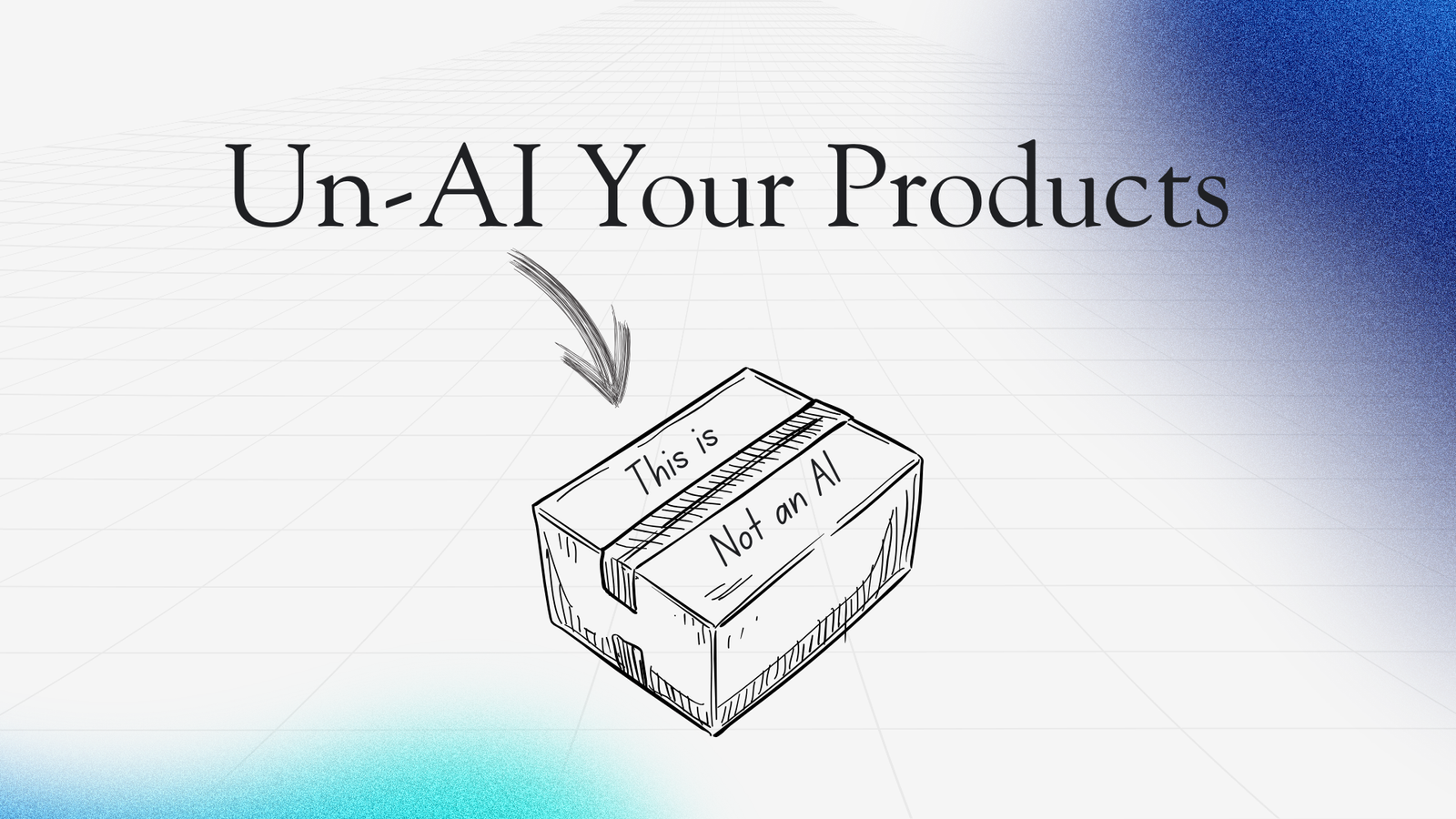
    So, the next time you write your landing page or pitch or product, try removing the words ‘AI-powered’.

    If the value still stands, you’re building the right thing.

    If it doesn’t, you’re probably selling the method, not the outcome.

    And outcomes are what endure.